Executive IntelligenceA discipline, not a course
Executives are not paid to have information. They are paid for the quality of judgment they apply to it. Each program develops one faculty of that discipline: reading an organization accurately, interpreting evidence rigorously, and deciding well under uncertainty.
Leadership Intelligence Snapshot
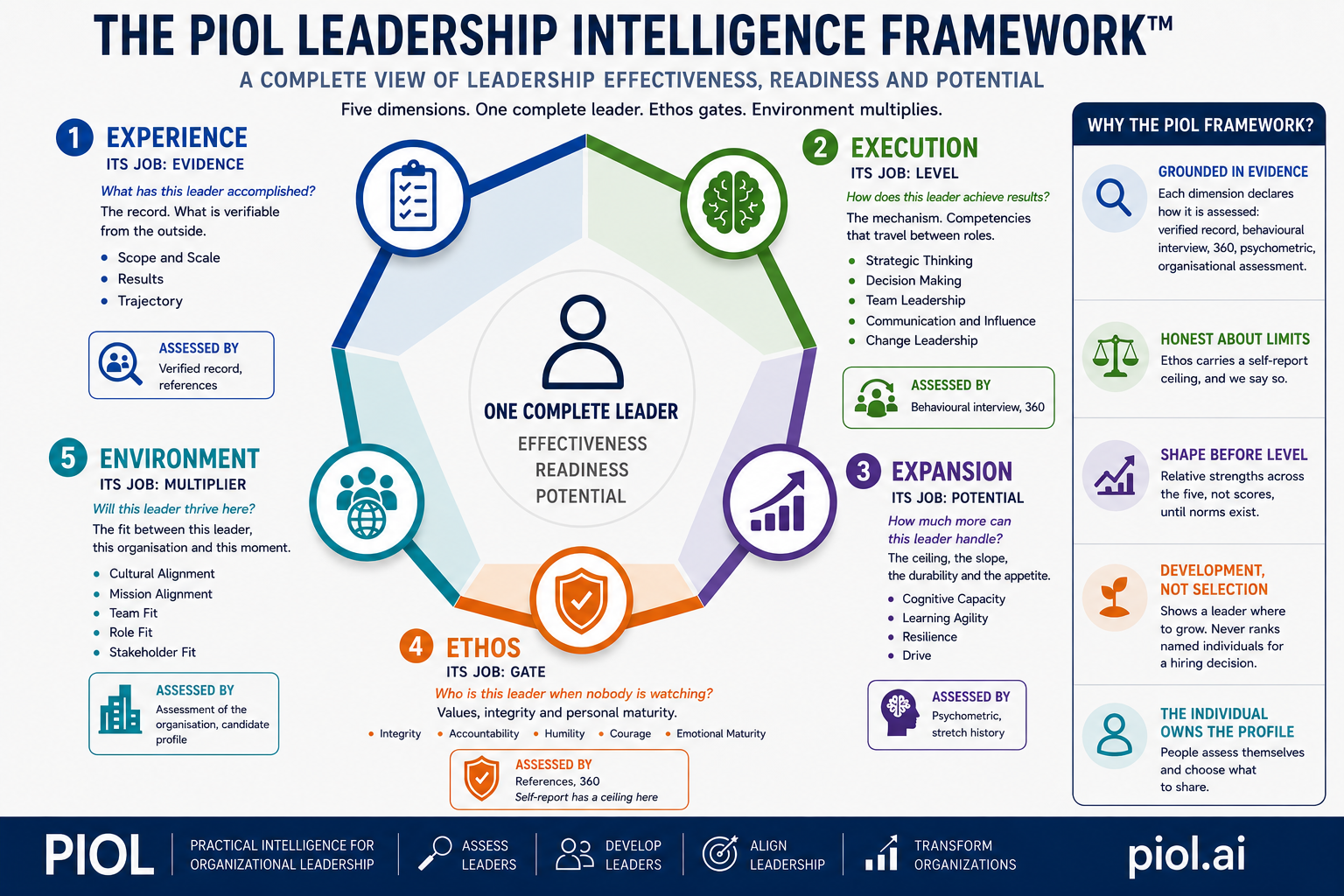
Thirty questions across the five dimensions of the PIOL Leadership Intelligence Framework: Experience, Execution, Expansion, Ethos and Environment. You get the shape of your leadership and the one place worth working on next.
No account needed. It is for your own development, and nobody uses it to make a decision about you.
Programs
Live from the Academy catalog. Every program includes executive worksheets, diagnostic templates, graded assessments, and a completion credential.
Capital Allocation Under Operational Uncertainty
Funding in Stages, and Stopping Without Calling It a Failure
After the Deal
What to Integrate, What to Leave Alone, and in What Order
The Team You Inherit
Assessing Capability, Fit and Trust, and Sequencing the Team You Build
Strategy to Execution
Converting Strategic Intent into Owned Work, and Making Room for It
Quality as an Executive Responsibility
Governing Quality as Enterprise Performance Rather Than as a Function
Safety as Enterprise Signal
Reading Safety Performance as Evidence of How Well the Business Is Run
Executive Risk Intelligence™
Detecting Emerging Risk Before It Becomes Failure
Executive Decision Intelligence™
Making High-Quality Decisions Under Uncertainty
Executive Governance Intelligence™
Designing Governance That Improves Decision Quality
The Leadership Operating Model
Making Leadership Behavior Visible, Measurable, Coachable, and Governable
Executive Operational Intelligence™
Seeing the Enterprise as an Integrated System
Executive Organizational Intelligence™
Separating Signal from Noise Before Making High-Consequence Decisions
This is an executive-level curriculum. It addresses something that very few leadership programs teach: how executives learn to accurately read organizations before attempting to change them. Most leadership courses teach communication, influence, and strategy. Very few teach organizational diagnosis.